AI Consulting
AI consulting that delivers for oil and gas.
We have built and deployed production AI across the energy industry. We bring deep domain expertise and engineering rigor to oil and gas industry problems where AI can move the needle.
Sound Familiar?
Are you trying to...
If any of these sound like your problem, we've either solved it or solved something harder.
Completions & Stimulation
- ›Detect well-to-well communication before it causes damage?
- ›Predict screenouts before they happen instead of reacting after?
- ›Figure out which completion designs actually perform better, and why?
- ›Optimize stage design and cluster spacing using real performance data?
Production & Drilling
- ›Identify artificial lift failures or rod pump issues before they cause downtime?
- ›Automate decline curve analysis or production forecasting across hundreds of wells?
- ›Detect drilling dysfunctions (stick-slip, vibration, washouts) in real time?
- ›Predict ESP failures or optimize gas lift allocation?
Midstream & Facilities
- ›Detect pipeline anomalies, leaks, or integrity issues from sensor data?
- ›Optimize compressor station performance or predict maintenance needs?
- ›Automate pipeline scheduling or nomination forecasting?
- ›Monitor emissions or flaring events with automated classification?
Geoscience & Subsurface
- ›Automate fault detection and horizon picking on 3D seismic volumes?
- ›Speed up seismic interpretation from weeks to hours with AI-assisted workflows?
- ›Classify lithology or facies from well logs using machine learning?
- ›Identify geobodies across large surveys without manual picking?
Property Evaluation & A&D
- ›Accelerate reserve engineering during acquisitions by automating decline curve analysis across thousands of wells?
- ›Predict undeveloped well performance from offset data, completion designs, and geology?
- ›Flag data quality issues and anomalous production histories during due diligence?
- ›Triage large asset packages to surface the wells that drive the most value?
The Urgency
The gap is already opening
Operators who adopt AI now aren't just saving money on today's wells. They're building proprietary data advantages that compound over time: better models, faster decisions, institutional knowledge that lives in software instead of in someone's head.
The companies that treat AI as a system to build around, not a tool to experiment with, are quietly pulling ahead. Six months from now, the gap between them and everyone still "figuring it out" will be obvious.
Waiting for AI to "mature" before investing is itself a decision: a decision to let competitors build the data flywheel first.
Compounding Advantage
Every well you run with AI-informed decisions generates data that makes the next decision better. Starting later means starting behind.
Talent & Knowledge Risk
Institutional expertise walks out the door every time an experienced engineer retires. AI captures that knowledge in systems that persist.
Competitive Pressure
Your peers are already investing. The operators who move first set the benchmark that everyone else has to catch up to.
Why Momentum
Built in the field, not in a lab
We cut our teeth on some of the hardest AI problems in completions: real-time frac-driven interference detection, automated stage scoring, sliding sleeve diagnostics from acoustic data. Our products (FDai, FracScore, BullsEye, StrataLink) were all built in-house, trained on real operator data, and deployed on live wells.
That experience taught us what it takes to go from messy field data to production software that people actually rely on. The same approach, the same engineering rigor, applies to any operational problem in upstream or midstream where there's data and a decision that could be smarter or more efficient.
We're not a slide deck shop. We build things that run.
Reduction in frac hit magnitude for one operator using FDai
Days of manual FDI labeling compressed by FDai Insight
Production AI products built in-house and deployed on live wells
Avoiding Failure
Why most AI projects fail, and how we don't
Most AI initiatives in oil and gas stall not because the technology doesn't work, but because of how it gets implemented.
No clear problem to solve
Companies buy AI tools because leadership feels pressure to "do something." Without a specific operational problem, the project drifts.
We start with Discovery. If AI isn't the right tool for your problem, we'll tell you that upfront and save you the investment.
Siloed adoption
AI gets piloted in one group, ignored by everyone else. No shared approach, no consistent results, no internal momentum.
We scope projects around cross-functional workflows, not departmental experiments. The people who use the output are involved from day one.
Skills gap and resistance
Teams attend a demo, nod along, and never open the tool again. Not because they don't care, but because they don't feel confident using it.
We build software that fits how your teams already work. No one needs to learn Python or understand neural networks to use what we deliver.
Poor integration with existing systems
The AI tool sits outside your main workflows, requires extra steps, and adds friction instead of removing it. People drop it within weeks.
We deploy into your existing systems and workflows. If it doesn't plug into how your team actually operates, we haven't finished the job.
Validated on test data, not real data
Models look great on holdout sets but fall apart on real operational data with all its noise, gaps, and edge cases.
We validate against your real data and field results. Our products run on live operations every day; we know the difference between lab accuracy and true reliability.
Delivered as a prototype, not a product
The engagement ends with a Jupyter notebook or a slide deck. It never becomes something anyone actually relies on.
We deliver production software. Deployed, integrated, and maintained. That's what we do with our own products, and it's what we do for consulting clients.
Active Engagement
Beyond our products
We're already applying our AI engineering capability to problems outside of completions monitoring.
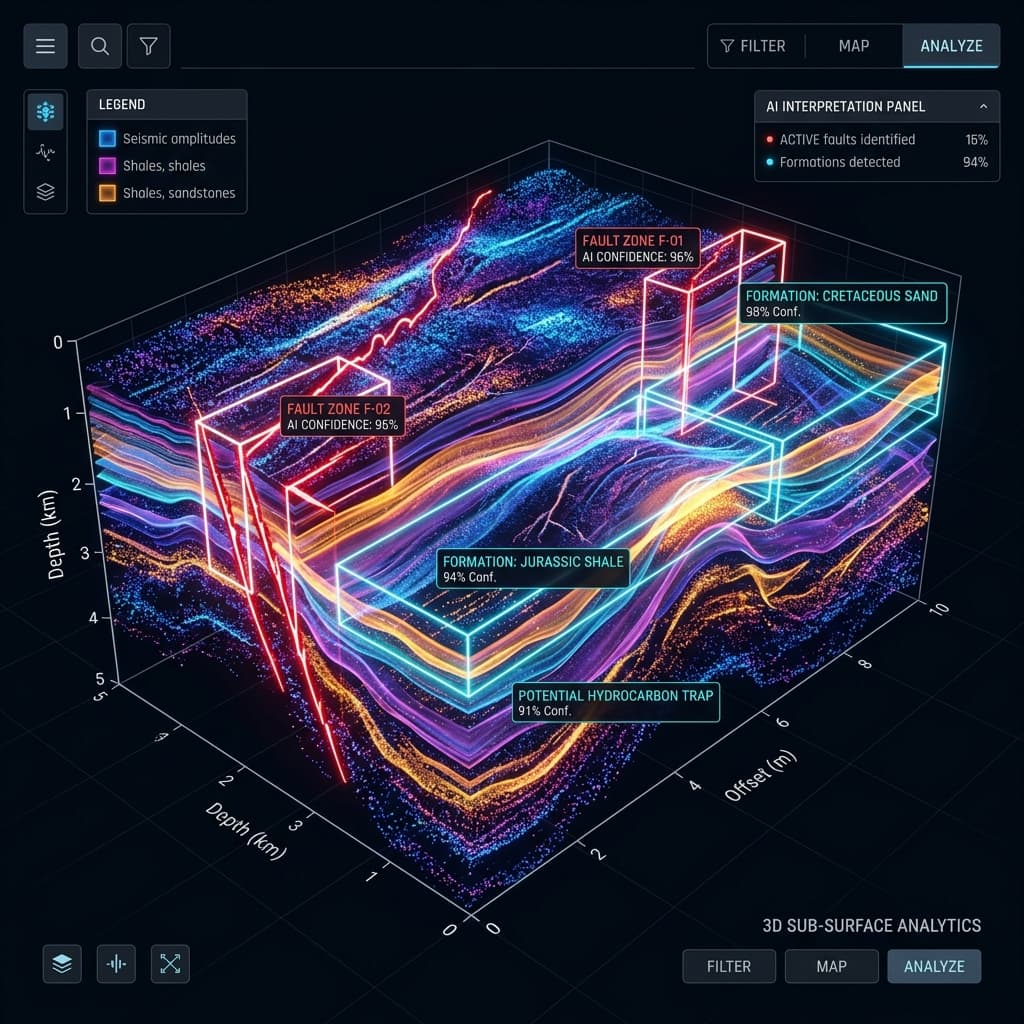
AI-Powered 3D Seismic Interpretation
Active ProjectWe're actively building an AI system for automated fault detection and horizon picking on 3D seismic volumes. The system segments geobodies, identifies fault networks, and picks formation tops across entire survey volumes, replacing hundreds of hours of manual interpretation with machine output that a geologist reviews and curates instead of building from scratch.
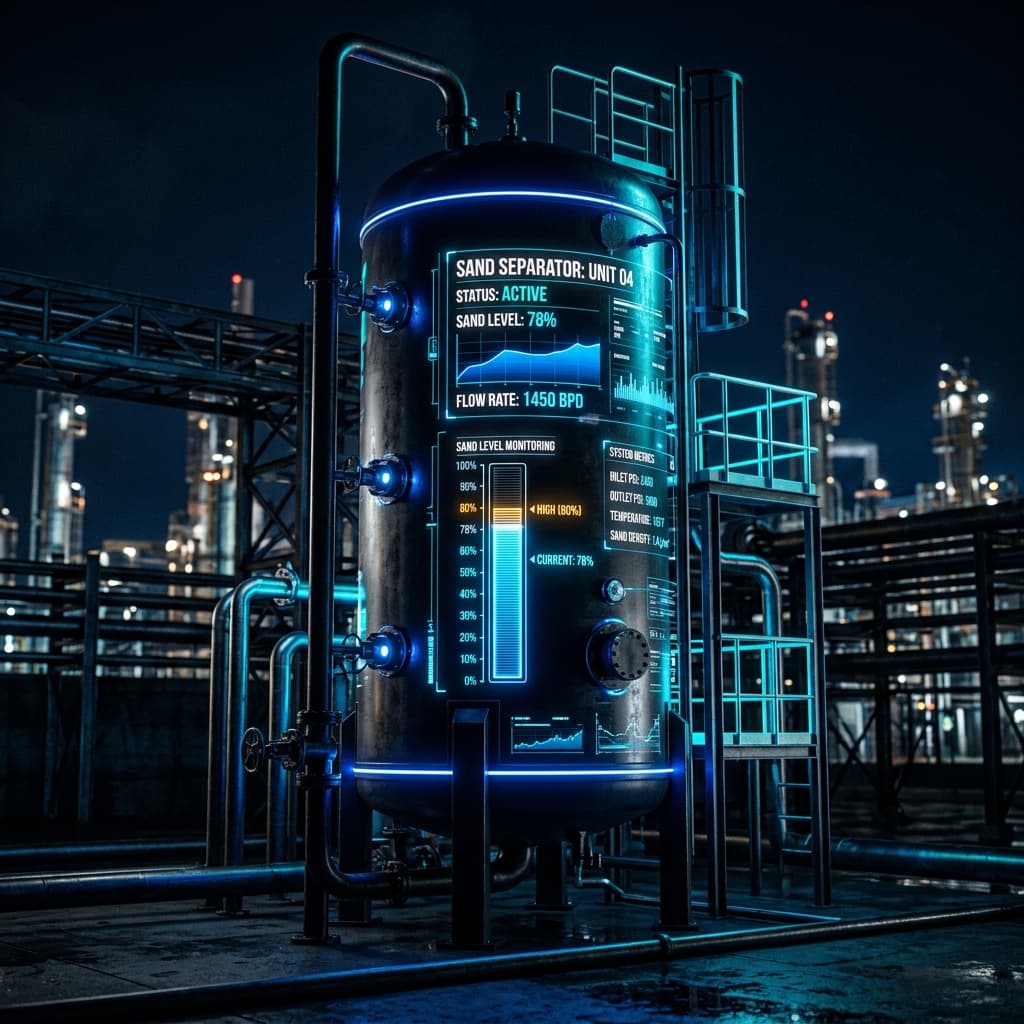
Sand Level Detection in Flowback Separators
Active ProjectWe're building an AI system that detects sand levels in flowback sand separators using accelerometer data. The model replaces manual checks and reactive dump cycles with continuous, automated monitoring that tells operators exactly when a separator needs attention.
Engagement Model
How we work
Clear phases, clear deliverables. No scope creep disguised as agility.
Discovery
We embed with your team to understand the problem, audit available data, and assess whether AI is actually the right tool. Sometimes it's not, and we'll tell you that.
Feasibility & Scoping
We determine what's buildable, what data gaps exist, and deliver a clear scope with timeline and cost.
Build & Validate
We prototype with your real data, iterate with your SMEs, and validate against field results, not just test metrics.
Deploy & Integrate
We don't hand over a Jupyter notebook. We deliver production software that plugs into your existing workflows and systems.
Tell us what you're trying to solve
We'll have a real conversation about whether AI can help, what it would take, and what you'd get. No pitch deck, no jargon. Or email us directly at reid@mxv.ai.